Threat Intelligene

Threat Intelligene
Cybersecurity today rarely fails due to a lack of information. It fails due to the wrong selection, missing context, or insufficient prioritization.
The sheer volume of information is not the problem.
The question is: which sources are reliable – and which are actually relevant to your organization?
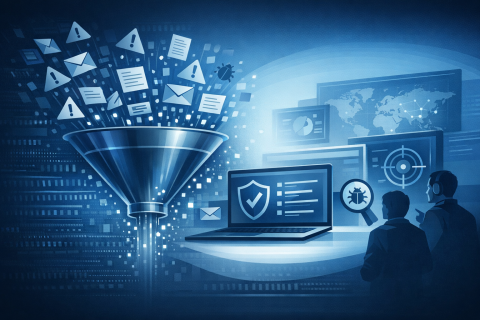
Our incident response experts rely daily on established national and international information sources to detect, classify, and assess risks at an early stage. The key is not to collect as many alerts as possible, but to derive a reliable situational picture from a large number of alerts.
In this article, we show which sources we use, how we evaluate them - and how this leads to concrete recommendations for action.
Poorly selected or insufficiently evaluated information sources carry a significant risk: critical threats are overlooked, operational resources are misallocated, or security measures are prioritized incorrectly.
Many organizations subscribe to numerous newsletters, feeds, and alerts – but without a clear structure, this quickly creates an information overload that consumes more time than it delivers value.
Professional threat intelligence therefore means:
Only this turns information into real operational capability.
Examples:
BSI, CERT-Bund, CISA, CERT-EU
Government agencies provide well-founded security advisories, vulnerability notifications, and an official situational overview. This information is structured, verified, and reliable.
Advantages:
Target audience:
Limitation:
The volume of alerts is high, but the context is often limited. Operational prioritization and assessment must be done by the organization itself.
Examples:
Microsoft, Cisco, Trend Micro und weitere Technologieanbieter
Manufacturers provide up-to-date information on vulnerabilities, exploits, and patches. For operational security teams, these sources are essential.
Advantages:
Target audience:
Limitation:
The perspective is fragmented and product-specific. Cross-organizational risk prioritization is not provided automatically.
Examples:
Verizon Data Breach Investigations Report, industry studies, market analyses
These reports provide valuable insights into attack types, trends, and threat developments.
Advantages:
Limitation:
Less suitable for daily operational decision-making. The focus is on higher-level developments.
Not every alert is relevant - and not every source is suitable for every organization.
When evaluating sources, our analysts focus in particular on:
Which supply chains and products pose the greatest risk in the event of a compromise?
Can concrete actions be derived from the information?
How critical is the threat, and how urgently does it require a response?
This is where experience from incident response engagements directly comes into play. Threats are not only assessed theoretically, but also classified based on real-world attack patterns and observed tactics.
Information alone does not create security.
Only through curated aggregation, contextualization, and prioritization does a reliable basis for decision-making emerge. Organizations do not need more feeds - they need clarity about what is truly relevant to them.
This is exactly where a structured threat intelligence approach comes in: alerts are assessed, risks are categorized, and actionable recommendations are derived that are both technically feasible and strategically sound.
Ein aktueller Fall zeigt, wie wichtig eine fundierte Bewertung von Meldungen ist:
Im April 2026 wurde eine kritische Schwachstelle in Adobe Acrobat und Reader (CVE‑2026‑34621) bekannt, die bereits aktiv ausgenutzt wurde. Auf den ersten Blick wirkte die Meldung wie eine von vielen – ein technisches Detail inmitten zahlreicher täglicher Alerts.
Bei der Analyse öffentlich verfügbarer Informationen zeigte sich jedoch schnell, dass es sich um eine Zero‑Day‑Exploitation handelte, die über manipulierte PDF‑Dateien Schadcode nachladen konnte. Technische Analysen belegten eine mehrstufige Exploit‑Kette mit verschleiertem JavaScript, AES‑Entschlüsselung und dem Nachladen externer Payloads.
Genau hier beginnt die eigentliche Arbeit:
Unsere Analysten bewerten solche Meldungen nicht nur technisch, sondern ordnen sie in aktuelle Angriffskampagnen, typische Vorgehensweisen und beobachtete Muster ein. Auf dieser Basis entsteht nicht nur eine Risikoeinschätzung, sondern eine klare Priorisierung:
Wie dringend ist die Bedrohung? Welche Systeme sind potenziell betroffen? Welche Maßnahmen sollten sofort umgesetzt werden?
Das Ergebnis ist nicht nur Kontext – sondern konkrete Handlungsfähigkeit.
Statt hunderte Alerts zu prüfen, wissen Sicherheitsverantwortliche, was sie tun müssen, in welcher Reihenfolge und mit welchem Zeithorizont.
Der Fall zeigt, wie schnell sich aus einer scheinbar technischen Randnotiz eine reale Bedrohung entwickeln kann - und warum es entscheidend ist, Meldungen nicht nur zu sammeln, sondern zu bewerten, zu priorisieren und in klare Maßnahmen zu übersetzen.
The flood of information is real - but it is manageable.
What matters is not the number of sources, but the quality of selection and the ability to put information into context. Those who take a structured approach save time, reduce operational burden, and minimize the risk of overlooking critical threats.
Curated threat intelligence helps turn alerts into actionable insights.
If you want to spend less time evaluating cyber threat alerts and more time on actual security measures, it is worth taking a look at HvS Threat Insights.
The newsletter provides:
Try HvS Threat Insights – 30 days free of charge.

Head of Incident Response
With many years of experience in analyzing and handling a wide range of security incidents, Moritz Oettle brings deep expertise in containing, remediating, and post-processing cyberattacks in his role as Head of Incident Response at HvS-Consulting.
He is the initiator of HvS Threat Insights – a curated threat intelligence format that helps organizations identify and assess relevant cyber threats at an early stage.